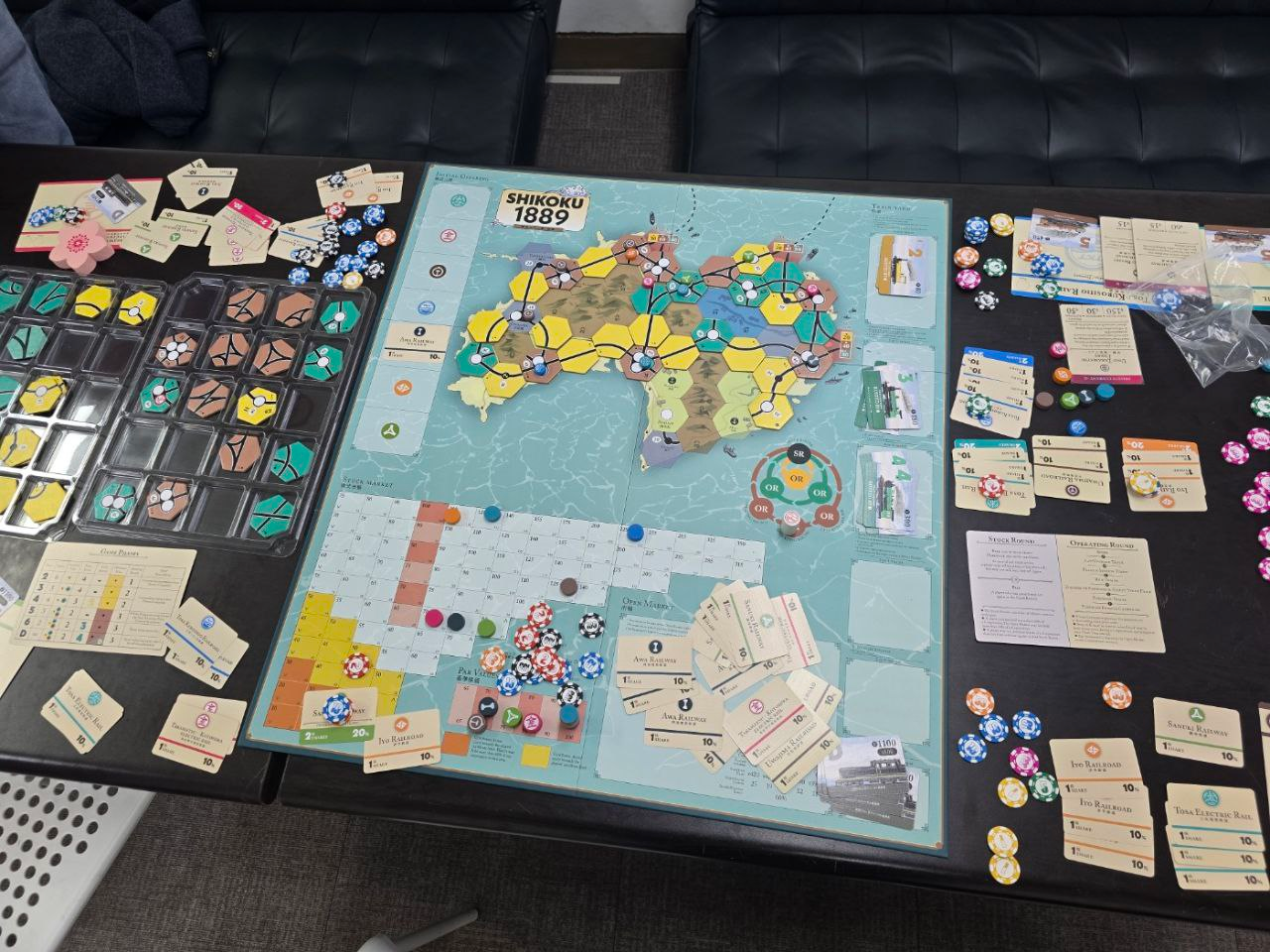
 Mid-game chaos: railway networks, stock certificates, and way too many poker chips
Last weekend, I got completely absorbed in Shikoku 1889, and honestly? It’s one of the most mathematically satisfying board games I’ve played in a while.
For those unfamiliar, Shikoku 1889 is an 18xx-style game where you’re building railway networks across Japan’s Shikoku island. But here’s what hooked me: it’s basically an interactive graph theory problem with economic constraints.
The Beautiful Math Behind It
Every decision in this game is a minimax optimization puzzle. You’re constantly balancing:
- Route optimization - finding the highest-value path through your network (literally a shortest-path problem, but inverted)
- Network connectivity - ensuring your graph stays connected while blocking opponents
- Resource allocation - finite capital, so many choices (classic constraint satisfaction)
Oh, and there’s a stock market layer on top of all this. You’re not just building railways - you’re managing portfolios, timing stock purchases, and watching market dynamics shift based on network performance. It adds this whole economic game theory dimension that makes every decision a multi-variable optimization problem.
Why It’s Actually Fun
The thing about Shikoku is that you’re not just solving one optimization problem - you’re solving a constantly evolving multi-objective optimization where the objective function changes based on what 3-4 other players do. It’s NP-hard decision-making, but somehow it doesn’t feel like work.
There’s something deeply satisfying about watching your railway network expand across the map, knowing that each hexagon placement is backed by actual mathematical reasoning. You’re doing graph coloring, path optimization, and strategic game theory simultaneously, and it all just… flows.
The emergent complexity from relatively simple rules reminds me of why I love mathematics in the first place. Simple axioms, infinite possibilities.
The Verdict
Would I play it again? Absolutely. There’s enough computational depth here to keep things interesting for dozens of games. Each playthrough is a new optimization problem with different initial conditions.
Plus, there’s something uniquely nerdy-satisfying about saying “I’m applying the max-flow min-cut theorem to my railway network” during game night.
Rating: 9/10 (would be 10/10 if games didn’t take 4 hours)